*Executive ghost-written work for venues like Piwik Pro and AdWeek available on request
Building Brand Voice.
Selected blogs
Ad-filtering users are a force to be reckoned with.
That’s not just because the demographic is impressively large—although that’s certainly true. Approximately 250 million users consent to being served nonintrusive ads while browsing, a practice known as ad filtering.
Yet, however impressive the sheer quantity of ad filterers is, it’s their qualities that have been a subject of even greater fascination. As we’ve noted before, this demographic tends to be tech-savvy, ad-aware, and digital-first—not to mention supportive of publishers and a valuable resource for advertisers.
Characteristics like the impact of social media on consumers’ behavior are widely acknowledged and documented, but equally important is the impact of media and popular culture. Marketing scholars agree taste plays a critical role in judgment and decision-making online (Source) and is a valuable consideration in any marketing strategy.
Thus, the eyeo team worked through data available on GlobalWebIndex (GWI) on internet behavior to investigate just how art and culture fit into the lives of ad-filtering users, and how that differs from the trends seen with other users.
How enthusiastic are ad-filtering users about arts and popular culture?
In a word: very.
When asked whether they self-identify with the term “arts and culture enthusiast,” 58.4% of ad-filtering users responded “Yes.” An even higher percentage—72.2%— of ad-filtering users self-identify as “pop culture and leisure enthusiasts.”
These numbers are significant, especially compared to non-ad-blocking users. Only 30.8% of non-ad-blocking users self-identify as arts and culture enthusiasts and 51.6% of non-ad-blocking users as pop culture and leisure enthusiasts.
If such significant gaps exist, it’s also representative of a different outlook and different priorities, something crucial to understand when addressing such audiences.
How much time are ad-filtering users spending online?
Continuing, when we examined the data concerning two primary online cultural pastimes—film/TV and audio entertainment—a trend emerged. Ad-filtering users spend more time engaging with arts than non-ad-blocking users.
Users who don’t block ads are more likely to forgo watching online TV/using streaming services than ad-filtering users, and nearly 40% of ad-filtering users report watching between ½ an hour and 2 hours per day—more than non-ad-blocking users. The trend continues: ad-filtering users are more likely than non-ad-blocking users to watch between two and four hours, and nearly twice as likely to watch 4 or more hours.
And, compared to non-ad-blocking users, ad-filtering users are likely to be devoted consumers of both podcasts and music streaming.
A higher percentage of ad-filtering users than non-ad-blocking users listen to more than four hours of podcasts and/or music streaming. They’re also more likely than non-ad-blocking users to listen to between 30 minutes and four hours of music streaming and to tune in to podcasts. Additionally, non-ad-blocking users are far more likely than their ad-filtering counterparts to forgo podcasts and music streaming.
What genres do ad-filtering users enjoy?
Ad-filtering users' tastes in TV entertainment genres are varied, although “films and movies” and “entertainment and variety” get top billing—the largest numbers of ad filterers report having watched these genres in the past week. And when ad filterers choose to consume TV for purposes of information and education, they overwhelmingly choose the genres of news/current affairs and docuseries.
While this is important for advertisers/brands to acknowledge, it’s also interesting, as with the data above, to consider what differences manifest between ad-filtering user viewing habits and the habits of non-ad-blocking users.
Across the board, all genres are more popular with ad-filtering users than non-ad-blocking users—but the genres that see the most discrepancy between the audience groups are the most popular.
66.5% of ad-filtering users watch films and movies in a typical week, compared to just 53.8% of non-ad-blocking users, and
70.5% of ad-filtering users watch entertainment/variety shows, compared to a mere 55.2% of non-ad-blocking users.
More than 2/3 of ad filterers reported watching the news in the last week, a higher percentage than non-ad-blocking users, and
55.5% of ad filterers reported watching documentaries in the past week, compared to 36.6% of non-ad-blocking users.
And when ad-filtering users listen to music, they are, in general, more likely to listen to a variety of genres than their non-ad blocking counterparts. Not only do they listen to more music streaming than non-ad-blocking users, but they have a more omnivorous approach to listening. Their tastes are wide-ranging and eclectic.
Responding to the answer “Which of these music genres do you listen to?” answers ranged from alternative to hip-hop, classical/opera to EDM/dance, R&B to jazz.
Why does this matter?
Perhaps unsurprisingly, the general trend in these statistics—the strength of ad-filtering users’ enthusiasm for culture and art—was mirrored when users were asked about their motivation for being online in the first place. This is a crucial point.
More ad-filtering users replied that they used the internet to “access/ listen to music” and “watch videos, TV shows, or movies,” compared to their non-ad blocking counterparts. Based on an ad-filtering MAGNA study, it was proven that uncluttered ad environments helped increase brand recall and trust for users.
Similarly in a GWI study, it was found that 23% more ad-filtering users discovered brands via ads seen on websites and 20% via ads on social media as compared to ad-blocking users.
What this means for brands and advertisers is that ad-filtering users, all in all, have a higher probability to view and engage with these ads.
For those of us with a general awareness of ad-filtering users and their role in the ad ecosystem, this doesn’t come as a surprise. After all, media consumption is generally less appealing when it’s broken up with intrusive ads.
When a user is served ads that neither disrupt nor dilute their browsing, they’re able to have a more satisfying and immersive cultural experience, whether their interest is film, fine art, music…or anything else that falls under the umbrella term of “arts and culture”. At the same time, they're able to better recognize the ads they do see, and are able to recall them more easily, rather than succumb to ad blindness.
Advertisers that specialize in these entertainment categories should consider targeting this valuable and reachable set of ad-filtering users in their campaigns. Learn more.
In today’s digital landscape, where ad-blocking technologies and user preferences shape the way we approach online advertising, finding a balance between creativity and respect for the user experience has never been more crucial. Many marketers and brands still believe that flashy, dynamic advertisements are essential to capture online users' attention. However, more often than not, the result is an intrusive and annoying ad experience that drives users to take matters into their own hands—such as downloading ad-blocking software.
Users today are tired of being bombarded with online ads and 81 percent of users have downloaded an ad blocker to avoid interruptive or annoying advertisements (2021 PageFair Adblock Report). By mid-2023, there were around 912 million global ad-blocking users (2023 eyeo Ad-Filtering Report).
Here are more statistics:
40 percent of U.S. respondents reported feeling "often annoyed by advertising on the internet" when asked about their attitudes towards online advertising (Statista). In the first quarter of 2024, only 31 percent of users approved of advertising in exchange for free content, down from 44 percent in 2019 (Statista).
The disconnect between advertisers and consumers
Yet, invasive ads are not the only problem users face. A significant disconnect exists between how advertisers design creative experiences and how consumers value these experiences. As mentioned, marketers often rely on dynamic or video ads, believing they are the most effective. However, auto-play video ads are actually seen as the most annoying ad format by users.
On the other hand, static ads or formats that potentially “limit” the expansiveness of an ad are often perceived by marketers and brands as stifling to their creativity. This, however, couldn’t be further from the truth—ad filtering, which imposes well-researched and industry-vetted or approved definitions on ad formats, offers an opportunity to innovate and engage users more effectively within the Acceptable Ads Standards framework, utilizing a provenly more user-friendly, and attention-conducive environment.
At the heart of effective advertising lies the principle of user-centricity. Modern users have shown a clear preference for nonintrusive, respectful ads.
According to research, 83 percent of users are open to seeing ads as long as they are nonintrusive, relevant and enhance rather than disrupt their browsing experience (eyeo research with CCM Benchmark, 2019). This insight underscores the need for a thoughtful approach to ad creativity that ultimately puts the user first.
Adapting creativity within constraints
Acceptable Ads has demonstrated that 400 million users appreciate light, nonintrusive advertising, allowing publishers to monetize content while maintaining a positive user experience. By placing user preferences at the forefront, we can create ads that are not only seen but appreciated.
The idea that creativity requires loud and flashy ads is a misconception. Even within the defined formats of Acceptable Ads, there's room to innovate specifically, by using more concise and compelling messaging above the fold and avoiding invasive techniques.
For example, user-initiated video ads can be effective without being disruptive, as it puts users back in the driver's seat. By giving users control over their ad experience, advertisers can build trust and engagement and get more attention than they would with more aggressive tactics.
Here are some ways to leverage creativity effectively:
Strategic placement and design: Utilize the limited ad space by placing key elements above the fold. As per the Acceptable Ads Standard, “all ads that are visible in the browser window when the page first loads must not collectively occupy more than 15% of the visible portion of the web page. If placed lower on the page, ads must not collectively occupy more than 25% of the visible portion of the webpage”. This approach ensures that the most important parts of your message are visible immediately, capturing attention without overwhelming the user.
Micro-moments: Capitalize on brief, valuable interactions. Provide concise, relevant content that addresses specific user needs or interests, making the most of limited space and time. A GWI survey conducted in October 2023 (Mobile Phone & Ad Behaviors - Oct '23 Zeitgeist) found that respondents described the ads they typically see on websites as distracting (31.4 percent), excessive (31.8 percent) and intrusive (30 percent). Only 13.7 percent find ads today relevant – which is why it’s even more important for brands to focus on relevancy
Here’s an example of a concise ad that works because it’s relevant, visually appealing, and includes an enticing value proposition and a call to action (source credit: Hubspot)
3. Compelling visuals: Effective use of visuals within a constrained format can create memorable experiences. Opt for clean and impactful designs that draw the user’s eye without being intrusive. According to GWI, while 23.2 percent of online users describe a website’s ad as ‘informative’ when asked, only 9.2 percent describe it as memorable(Q3 2020 wave).
The value of prioritizing the user
Respecting user preferences isn’t just about avoiding intrusiveness; it's about building trust and delivering value. Gathering user feedback is crucial for understanding what works and tailoring ad content to meet expectations, which fosters a positive relationship with your audience.
By aligning your ad strategies with user preferences, you can enhance user satisfaction and improve ad recall and brand trust. For example, ads in low-cluttered environments (i.e. ad filtering) have been shown to increase brand trust by 9 percent and aid ad recall by 82 percent (MAGNA ‘Reaching and Influencing Ad-Filtering Users’, 2023).
Advertisers should shift focus from short-term metrics to user engagement indicators like attention and interaction. This shift requires industry-wide collaboration and a user-first mindset. Education is also key—users need to be informed about their choices and how their data is managed.
The future of creative advertising
By embracing innovative approaches within the framework of ad filtering, you can deliver ads that engage, inform and delight without disrupting the user experience, elevating the brand identification users have.
Prioritizing user feedback, leveraging data responsibly, and focusing on respectful ad formats will keep your strategy effective and user-centric. As the industry evolves, staying at the forefront of these practices will help you build stronger connections with your audience and achieve lasting success.
Discover more about our recent panel discussion at Cannes where we explored this topic in depth. Read the full recap in our Campaign US article.
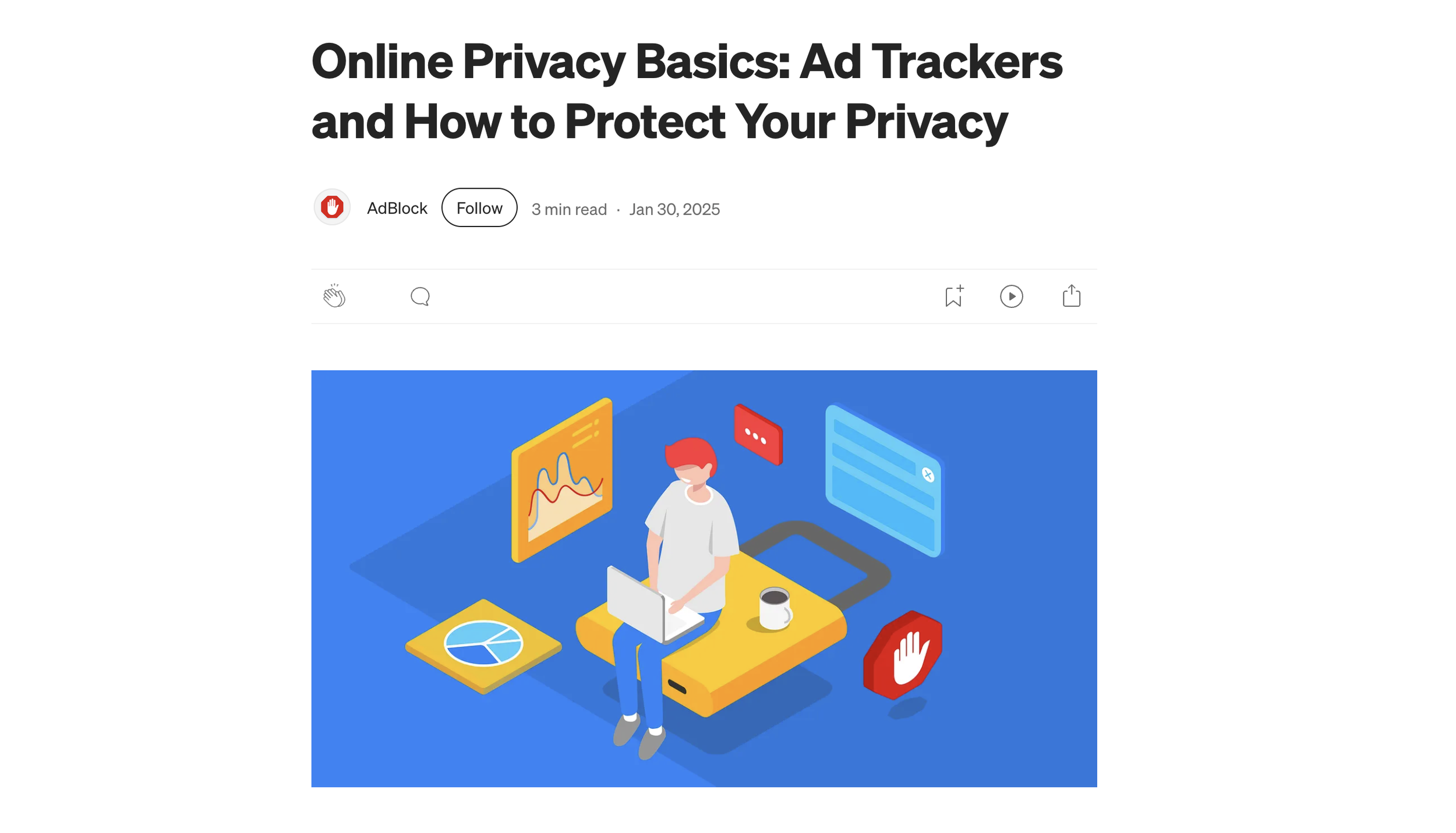
Do you ever feel like an ad is following you around online? Sometimes you look at a product on a website and it keeps popping up in ads everywhere else you browse. Online tracking methods are becoming increasingly sophisticated, allowing advertisers and websites to collect detailed data about you and your online behavior.
Not all trackers are collecting top-secret information and some are attempting to personalize content and products. Even so, the more we are aware of what data is being collected, the more control we have over who has access to our personal information.
Common tracking techniques
Pixel Tracking: Invisible 1x1 pixel images embedded in ads, emails, social media sites or web pages that collect data when you view or interact with content.
Cookies: Cookies are small data files stored locally on your device that can be temporary or permanent, first-party (directly from the website) or third-party (set from a different domain, usually an external advertiser or analytics provider).
Browser Fingerprinting: Your browser fingerprint identifies you based on unique browser and device characteristics.
Cross-Device Tracking: Trackers are deployed, often in the form of unique identifiers, cookies and account credentials (and more) to build your profile across multiple devices, such as smartphones, personal computers, tablets and smart TVs.
Data Collected by Ad Trackers
Data allows advertisers to create detailed user profiles, personalize ads and measure campaign effectiveness. However, the ad trackers collecting this data also raise privacy concerns, leading to increased scrutiny and regulations of online tracking practices.
Various studies highlight the “advertising paradox” which is that the majority of people generally want personalized ads, but they also want to protect their privacy.
We are in times of immense flux online. Users of content platforms like YouTube, Facebook, Instagram (or any other site that leverages subscriptions as an alternative to seeing ads) are experiencing a barrage of messaging screens asking them how they want to access and support content.
Currently trending is YouTube’s latest anti-ad-blocking efforts. Users are being warned that they will be blocked out of YouTube if they do not turn off their ad blockers, leaving them the choice of either watching videos with ads or paying 12.95 EUR ($13.99 USD) a month for YouTube Premium.
The ironic twist, at least from YouTube’s standpoint, is that they’ve put ad blocking and ad filtering in the spotlight, bringing these services to the attention of new users, previously unaware or uninterested before these anti-ad blocking changes. Recent data shows that terms like "Youtube ad blocker" and "block youtube ads" are increasingly being searched, and many recent blogs are also ranking for some of these YouTube and ad-blocking terms.
YouTube’s popularity is such that its decisions have served as a veritable starting gun for a larger, more inclusive campaign for discussing the online value exchange. Now, it seems like everyone is talking about ad blocking, monthly subscriptions, and how the internet “is changing”.
Funding content
However, finding sustainable ways to fund content is nothing new — publishers have always looked for ways to effectively monetize their work, and deservedly so. That’s why at eyeo, we create solutions that support publisher funding and respect the user experience. The relationship between users and publishers is vital and at the core of the online ecosystem.
The difference now is YouTube’s recent experimentation with soft walls (messaging walls you can click out of) and hard walls (ones you can’t click out of) has reached a massive scale of people. As of 2023, YouTube has more than 2.70 billion monthly active users, meaning literally half of the world is watching.
For us, this current situation reveals two things. (1) The web is in need of better, sustainable guidelines for how content can and should be consumed and (2) user needs should not be ignored. That means finding ways to offer user-centric options for content consumption that also enable others in the ecosystem, like publishers and advertisers, to see to their own needs.
Content cannot be free. People write it, create it and make it available, all of which is essential. But making access to content difficult or costly also negatively impacts our society where certain groups are unable to access said content.
How is the industry reacting?
At the moment, YouTube’s efforts have resulted in various reactions from the online community. Some ad blockers are taking the aggressive (and possibly illegal) route of jumping over YouTube’s messaging pop-up. This is in sharp contrast to eyeo’s products, which simply find new ways to block the same old ads.
Of course, this aggressive reaction was inevitable. Many people feel compelled to resort to ‘all-out-blocking methods’ when faced with anti-ad-blocking efforts, which create an antagonistic feeling between stakeholders.
But all-out, total ad blocking has the potential to push more and more content behind paywalls, as publishers could see that as their only solution. We know that blocking all ads is not sustainable. It’s a hard-nosed approach with no winners and moves us all in the wrong direction of circumventing one thing with another.
That’s what we mean about opening the conversation. We need solutions that facilitate healthy relationships, and sustainable ways for users to have access to content under agreeable conditions, while publishers are also able to earn their daily bread.
eyeo’s position
At eyeo, we focus on ad filtering, not all-out ad blocking, and have built our business model around the concept of Acceptable Ads — a standard for advertising online that is tested and vetted by the independent Acceptable Ads Committee. Acceptable Ads, which shows lighter, nonintrusive forms of advertising, is overwhelmingly supported by users, with over 94% of Adblock Plus and AdBlock users seeing Acceptable Ads during their browser experience1. That means 307 million ad-filtering users, who are provenly not against all advertisements.
We believe approaches that strive to find a middle ground are what will enable all members of the online community to have a generative relationship.
Communication and user-centricity open the door to move forward. And we hope to have more productive conversations with publishers, advertisers and users alike as we evolve our approaches along with the rapidly evolving landscape of the online world.
1 2023 eyeo Ad-Filtering Report, based on new data analyzed between Q1 22 - Q2 23
These days you might hear “data protection” mentioned more frequently. It’s a topic that has become a part of our collective unconscious. Thanks to the efforts of organizations like the National Cybersecurity Alliance, the International Association of Privacy Professionals (IAPP), and Mozilla, the importance of data privacy and protection has grown in visibility and, hopefully, will continually garner higher priority in businesses’ agendas.
As long-time advocates of privacy on the web, we at eyeo want to mark the upcoming Data Protection Day by shining a light on concerns and trends within the realm of online privacy, for we see it as a societal problem. Thus, we sat down with our Group Data Protection Officer, Cornelius Witt, to discuss the state of affairs, solutions and complications prevalent in the field
Data Protection Day – can you explain what this day means and where the idea comes from?
Originally, the Council of Europe initiated the Data Protection Day in 2006. Back then, polls showed that 70% of European citizens did not understand how their personal data was being protected. Thus, as a reaction to this lack of awareness, the Data Protection Day was born.
The 28th of January was chosen as it was the date when the Council of Europe’s data protection convention, known as “Convention 108”, was opened for signature. The “Convention 108” is the first international treaty that aims to protect the personal data of individuals. By now, 55 countries have signed and ratified the Convention.
But what does Data Protection Day stand for today?
Well, over time, Data Protection Day has become a global phenomenon. Organizations across the globe celebrate Data Protection Day – or Data Protection week, even – for instance with companies releasing new privacy-enhancing features or NGOs initiating awareness campaigns on the importance of privacy.
And what is meant specifically by “privacy” in our current online world? Sometimes it’s used as a catchall.
I do think there are two dimensions to this answer: on the one hand, from a more legal point of view, privacy is a fundamental right. The Declaration of Human Rights of the United Nations defined privacy and the protection against attacks against or interference with personal data as a universal right, similar to other individual rights, such as the right to freedom of expression or the right to seek asylum. And this fundamental right is then manifested in more concrete laws, such as the GDPR in Europe.
On the other hand, privacy has also become a more critical topic from a societal and business perspective: More and more laws provide legal protection for citizens, whereas at the same time many businesses are shifting their stance on privacy as well. One example for this is the privacy tech sector, meaning technologies that preserve or enhance privacy by having fundamental data protection principles built-in. This market is booming right now, with privacy startups receiving more than $4 billion in investment in the over 500 funding rounds.
So, how has privacy become also a socio-political issue? What implications does it have on our lives and society in general?
It’s interesting to think about this question from a historical perspective: the very first attempts to legally protect an individual’s privacy aimed to safeguard citizens against interference from government or rulers. Nowadays, at least in most parts of the world, the focus has shifted to protect the privacy of users against the practices of private corporations, even though government access practices remain a data-protection issue as well.
A very current example on the societal implications of privacy is the use of facial recognition software: many organizations and politicians are calling for a general ban on facial recognition, arguing that this technology is fundamentally undermining privacy and, when adopted in public places for instance, creates a de-facto surveillance. Others see benefits in this technology, for example in law enforcement. And, no matter which side of the issue you stand on, this crossroads of privacy and technology clearly shows the huge societal implications we are witnessing.
As you mentioned the role of the user – what is your take on the so-called “privacy paradox”?
The “privacy paradox” was first coined by researcher Barry Brown in 2001, who worked at HP and found out that there is a disconnect between what users say about privacy and how they actually behave. In a nutshell, the paradox says that users are saying that they care about their privacy, for instance in surveys, but they actually don’t make privacy-friendly choices regarding the services or apps they use.
For a long time, I was a strong supporter of this hypothesis, as so much evidence pointed in that direction: while studies often recorded that users say they care about their privacy, the actual user behavior showed the opposite, and people did not seem to, in truth, care if services were infringing upon their privacy.
Having said that, what I see more and more is that the “privacy paradox” seems to be more and more outdated. For example, the recent uptake of WhatsApp competitors is a good indication of this: in spring 2021, reports showed a stellar 1200% uptake in downloads of Signal and Telegram, coinciding directly with WhatsApp being heavily criticized for their announced privacy policy changes. Another example are projects like the 4Privacy app, which raised over $600,000 on Kickstarter to develop a private communications app.
So, my hypothesis is that the “privacy paradox” is becoming less and less applicable. We have ever more wells of information to suggest that actual, tangible changes are happening.
What can businesses do to protect consumers’ data?
In general, I think it’s crucial that companies fully implement the core privacy principles, such as collecting as little user data as possible and only to the extent that is really necessary. This is not something particularly new, but I see so many online services that do not follow these principles, e.g., by requiring users to set up an account and providing personal information where it would not be relevant for the service as such. Also, I believe that companies should have a very good understanding on data governance, meaning that organizations should be fully aware of all personal data they hold and how this information is processed. Especially for data-driven companies working across many teams, this can be challenging, but it is an absolute necessity, and more and more privacy tech providers offer innovative solutions for this.
Lastly, I think the potential for data anonymization and pseudonymisation is not yet being fully implemented in the market, and there are many ways how data can be used compliantly when properly anonymized or pseudonymized.

We recently contributed a series of privacy-related questions to a GWI study of 4,009 UK and US users. To achieve a more balanced and fairer digital world, it's essential to listen to users' voices, especially when it comes to their privacy. As an additional bonus, the results were quite inspiring, as we saw how the views of those users dovetailed with our own. As a company vested in fostering data privacy as a basic human right, it's further proof that we’re on the right path.
Excited to see what users had to say? Let’s go through some of the results.
Factors influencing comfort with data sharing
It is no surprise that the two highest ranking responses — 60.9% and 59.3% — regarding the most important factors for a user to know before they’d feel comfortable sharing data are, how will my data be used? and how will my data be protected? As we’ve seen, it's exactly this lack of transparency that is driving the new data privacy revolution. Users want to be a part of the discussion. They want to know just how and in what ways companies are profiting from their personal information. How can a user feel safe if the rules of the game are not clear? The following highest ranked factors attest to that further: Why are they collecting it (data)? and will my data be anonymous?
Our data is precious and sensitive, and thus it is of paramount importance to empower users by pushing for better industry practices and educational efforts. Informed stakeholders can, and should, establish functional data governance models that account for these aspects.
Online data sharing
What is interesting about the results from the second question, “Which of the following data types, if any, are you willing to share with an app or company” is that they represent the most basic information, things that are not used to easily identify a specific individual. These broad, large-level data types don’t narrow the spectrum in the way your medical history or bank data would.
To wit, 65.1% responded they are okay with sharing their gender, 55% their country and 51.9% their language (the second and third of which are generally practical as first-party information on favorite websites to save some settings for user convenience). Whereas only only 28.5% wanted to share their history of past purchases, i.e. information that narrows in on them as individuals.
Currently topics-based targeting is one of the most interesting proposals brought forth by the industry as an alternative to profiling users — our privacy product Crumbs and Google’s Topics API being two possible viable solutions in this vein — and these results show that it's exactly this need to avoid being too closely identified as an individual that most concerns users.
Factors influencing browser choice
So this all leads to the big question: which browser should I use then? What factors are most important to me when using a mobile web browser?
Of course, it’s no surprise that the first-ranked answer was performance related, the speed when loading websites (44.9%), but what is highly interesting is that a close second (40.6%) was privacy & security features (e.g. anti tracking). Performance has always been, and will always be, a primary consideration when choosing a browser, and yet, it speaks volumes to the current moment in the online environment that right next to performance is privacy. It's no longer a buzzword. The data revolution really is in the here and now. And companies will need to respond to these user needs or fall behind the times, or risk noncompliance with changing GDPR or CCPA (state law in California) governance, to name a few.
Moving forward and continued discourse
An active approach toward transparency and working with users to find sustainable solutions, as with topics-based data collection, is the way forward and the path we’re forging at eyeo.
Because we believe the discourse around this topic is so important, our CRO Jan Wittek recently presented a session at MozFest titled “The Next Data Revolution”, where he focused on just these topics of end-users’ data, with an emphasis on empowering users by giving them the means to control and benefit from how their data is used.
This is something that we want to continue doing, being as much a part of the conversation as possible, and helping our partners and their users to have the peace of mind that comes from transparently handling user data across the industry. We believe that fostering user privacy is not a hindrance for businesses, but rather a unique selling point, as it is exactly this kind of prioritization of privacy that will define the internet moving forward. Not only that but it shows that they are listening to users’ voices, which is not only good business but essential for the digital world.
If you missed our session at MozFest, you can watch the recording here. Please note that you need to register on Mozilla’s platform to do so.